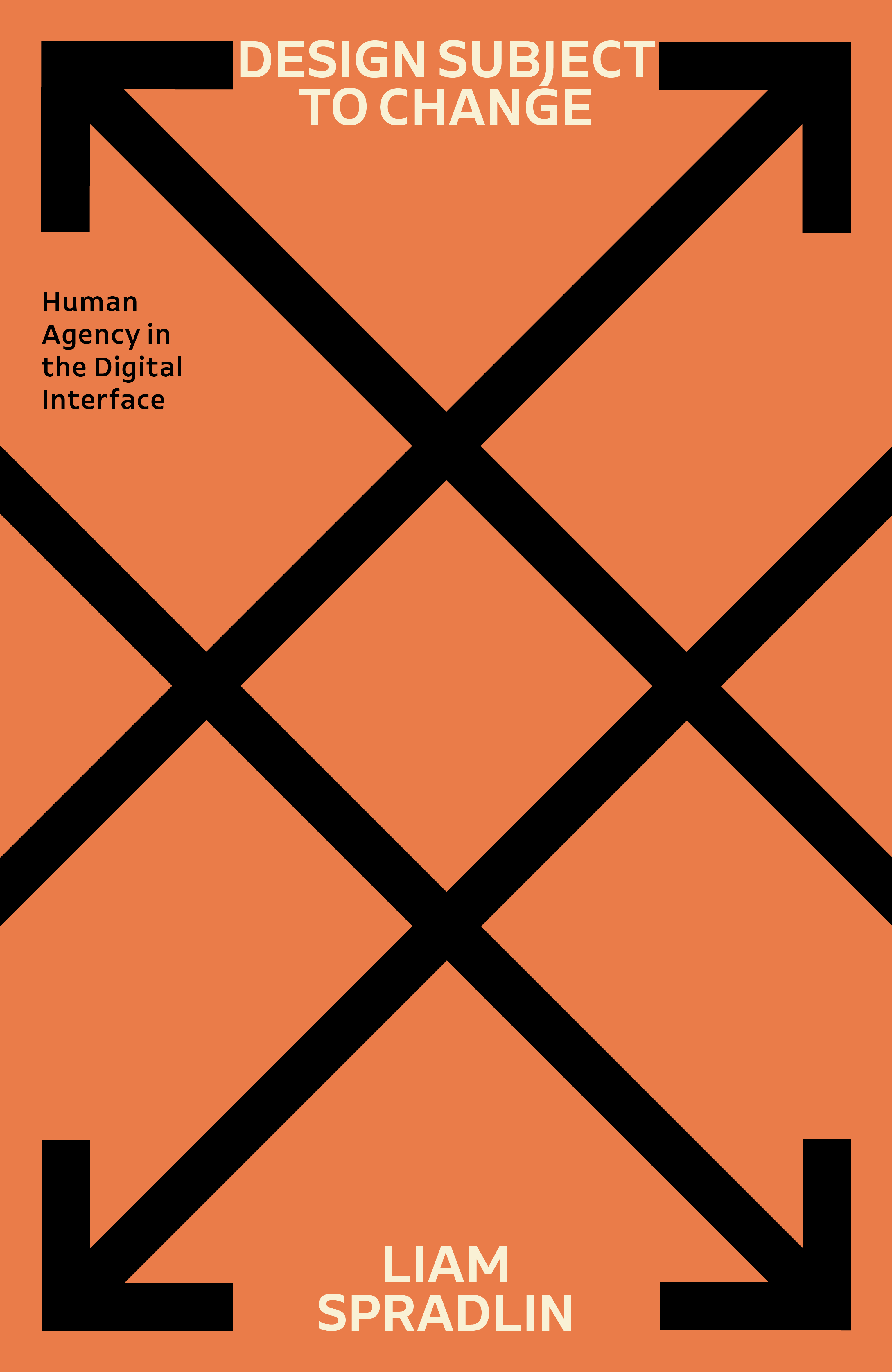
Design Subject to Change
Human agency in the digital interface
Get pre-order updates“Whether you’re an optimist eager to enter the tech world or a disillusioned insider fed up with it, Design Subject to Change will provide guidance, insight and perhaps even renewed enthusiasm.”
“Spradlin traces how interface design traded its early optimism for metrics, then does the harder work of describing what designers could build instead. A useful, personal, and hopeful book for anyone who makes things on screens.”
Many of us entered interface design with a deep, humanist optimism: that software's endless plasticity could help people make sense of the world and solve real problems. Instead, designers find themselves leveraged; squeezed into building hostile digital environments that reduce agency, flatten subjective experience, and manipulate—rather than facilitate—human intent. Now, as an industry rushes to feed decades of human craft into generative AI models, interface design faces an existential rupture.
Part confession, part manifesto, Design Subject to Change is a candid dispatch from a designer caught in the middle. Moving from the basements of Silicon Valley to the backrooms of the MoMA to the sun-drenched coast of Portugal, Spradlin traces how tech's obsession with quantifying the world has changed how we interact with it.
Design Subject to Change isn't a doomer eulogy of design or a how-to guide. Drawing on design history, sociology, philosophy, and more than a decade of experiences shipping the interface at scale, the book reminds us that while design is routinely used to change its subjects, the practice itself is still ours to change.
Instead of asking how to make interfaces more frictionless or efficient, Design Subject to Change asks how to make them accountable to human life:
How did the belief that all of reality (down to taste, sleep, and creativity) can be quantified become tech's governing philosophy? From 18th-century weaving to today's AI "Geniuses in a datacenter," the book unpacks the metaphysics underlying Silicon Valley's machines.
Software isn't just a tool we pick up and put down; it's an environment that impacts how we live, think, and work. Looking beyond the screen reveals how "frictionless" optimization deskills users and designers alike.
Experiences can't be packaged and deployed. Users co-create meaning through self-design. Letting go of the myth of the designer's "seat at the table," the book demonstrates how to build porous interfaces.

Design Subject to Change arrives in Spring 2027 from Set Margins'. Join the list for early chapter excerpts, pre-order access to the first Ota-bound printing, and details on launch events in New York, Zurich, and Berlin.
Here are a few places to explore more about the future of the interface while you wait for the book.
Exploring the creative processes of leading thinkers across design, arts, and research.
Writing and reflections on design, technology, and culture delivered to your inbox.
A collection of notes, images, and links exploring design, technology, and culture.
An essay on computism, adapted from ideas in the book.